
What Are We Actually Measuring: Sensor Data Definitions
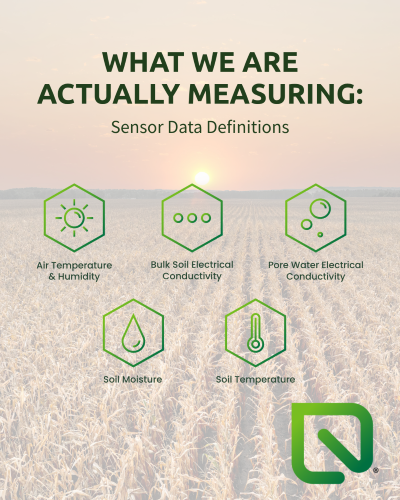
Our sensors collect a range of data points, and it's easy to see the numbers without fully understanding what they represent.
This blog aims to be a quick and easy reference for what each reading is, how it's measured or calculated, and what it tells you. Bookmark it so you can come back whenever you need a refresher!
Soil Measurements
Here at EarthScout, we use Time Domain Reflectometry (TDR) sensors to take soil moisture, soil temperature, and soil electrical conductivity (EC) readings. These sensors are considered the gold standard for accuracy, install into undisturbed soil, and no calibration or slurry is required for use. Below are the definitions of those readings.
Volumetric Water Content (VWC)
VWC is one of the most fundamental readings our sensors provide. It's a direct measurement of the ratio of water volume to total soil volume, expressed as a percentage. In simple terms, it tells you how much of the soil in the sensor's measurement zone is actually water versus solid particles and air.
This is the number most growers check first, because it answers the most basic irrigation question: is there enough water in the root zone right now? Tracking VWC over time helps you understand your soil's water-holding capacity, spot irrigation inefficiencies, and avoid both under- and over-watering.
Soil Temperature
Soil temperature is exactly what it sounds like: a direct measurement of soil warmth, displayed in either °F or °C. It's a simple metric but plays a major role in plant health. Root development, nutrient uptake, microbial activity, and seed germination are all temperature-dependent processes.
Soil Bulk EC (Electrical Conductivity)
Bulk EC is a direct measurement of the soil's ability to conduct an electrical current, which is influenced by the presence of ions throughout the soil matrix. Because this reading accounts for solid particles, water, and air all together, it serves as a broad indicator of overall soil salinity and nutrient availability.
Think of Bulk EC as a whole-soil snapshot. It's useful for understanding general trends in your growing medium, but because it lumps together everything in the sensor's field, it isn't the most precise tool for making fine-tuned nutrient decisions on its own.
Pore Water EC (Electrical Conductivity)
Pore Water EC takes the Bulk EC a step further. Rather than measuring the entire soil matrix, it's a calculated reading, derived using the Hilhorst model, that represents the electrical conductivity of the water held within the soil's pores. This is the water that's most available to plant roots, which makes Pore Water EC the go-to reading for most growers when it's time to make salinity and nutrient management decisions.
Because it isolates the conductivity of plant-available water rather than the soil as a whole, Pore Water EC gives a more actionable view of what your crop is actually experiencing.
Air Measurements
Our air temperature and humidity sensors supply data points on above-ground environmental conditions.
Air Temperature
Air temperature measures how warm or cold the ambient air is, displayed in either °F or °C. Paired with soil temperature data, this reading helps growers understand the full environment a plant is experiencing above and below ground. Sudden swings in air temperature can signal stress conditions before they show up physically on the plant.
Relative Humidity
Relative humidity measures the concentration of water vapor present in the air, typically expressed as a percentage. This reading matters because it directly affects transpiration, the rate at which plants lose water through their leaves. Low humidity can increase water stress even when soil moisture looks fine, while excessively high humidity can create conditions favorable for fungal disease. Monitoring humidity alongside air temperature gives a much clearer picture of the atmospheric demand your crop is under.
The Recap
Volumetric Water Content - how much of the soil is water (or wet), by percentage
Soil Temperature - how warm or cold the soil is
Bulk EC - how well the whole soil conducts electricity, a general salinity/nutrient indicator
Pore Water EC - how well plant-available water conducts electricity, calculated from bulk EC and soil moisture readings using the Hilhorst model
Air Temperature - how warm or cold the surrounding air is
Relative Humidity - how much water vapor is in the air, by percentage
That's the full lineup, six readings that together paint a picture of what's happening above and below ground. Knowing the definition of what each reading is makes it easier to understand and digest your data. Come back anytime you need a refresher on data reading definitions!
Learn more by visiting the How It Works page here.